
Original report

Standfirst: Tonight, the 2026 Nobel Prize in Physiology or Medicine was announced in Stockholm. For those of us who have spent decades working on GLP-1, the announcement inevitably brings a certain feeling. But the first image that came to my mind was not Stockholm. It was Milan, just a few days ago—and a familiar seat in the front row.
Tonight, the 2026 Nobel Prize in Physiology or Medicine was announced in Stockholm, honoring three scientists for their pioneering discoveries in light-gated ion channels and optogenetics.
For those of us who have spent decades working on GLP-1, the announcement inevitably brings a certain feeling: perhaps the day for incretin biology will have to wait a little longer.
But the first image that came to my mind was not Stockholm.
It was Milan, just a few days ago.
Milan: The Same Seat
This year’s EASD Annual Meeting was held in Milan.
On September 29, I happened to run into Daniel Drucker between sessions.
“Hi Dan!”
“Hi Qinghua!”
A handshake, a brief exchange, and we were both on our way.
The next day, I walked into a clinical session on GLP-1. Dan was already there.
Front row. First seat on the left.
After the first presentation, he quickly made his way to the microphone and asked a question—one of those questions that immediately elevates the discussion.
For nearly thirty years, it seems to me, Dan has always been in that seat.
ADA: The Man Who Arrived Early
I remember one ADA Scientific Sessions many years ago. I was scheduled to speak at eight in the morning and arrived at the room thirty minutes early.
The audience had not yet arrived.
Dan was already sitting there, in the first seat on the left in the front row.
“Hi Qinghua!”
“Hi Dan—you are so early!”
“Yep, waiting for your talk…”
We talked a great deal during that meeting—about GLP-1 biology, and about the development of GLP-1-based medicines.
It was during one of those conversations that I learned Dan slept only about five hours a night, yet somehow maintained an extraordinary level of energy.
Whenever I saw him at meetings afterward, I would remember that conversation. He always seemed to arrive a little earlier than everyone else.
For three decades, that has been my impression of him: arriving early, listening carefully, and invariably finding the question most worth asking.
Toronto: “I Was One Step Late”
After receiving my PhD in biochemistry from the University of Antwerp in 1995, I moved to the University of Toronto for postdoctoral training.
Dan later served as Director of the Banting and Best Diabetes Centre. At the Centre’s annual meetings, he would present the director’s report—finances, the year in review, plans for the future—followed by scientific lectures and poster discussions.
By then, GLP-1 had already become one of the most exciting areas of research at the Centre.
I eventually joined Patricia Brubaker’s laboratory to work on GLP-1.
There is a story behind that.
When I was looking for a postdoctoral position, I had actually written to both Dan Drucker and Pat Brubaker. Less than five minutes after I sent the emails, Pat called me. She was delighted to invite me to join her laboratory.
Many years later, during a casual conversation, I teased Dan:
“Dan, I applied to your lab back then, but you never replied to me.”
He laughed.
“Yes. By the time I read your email that evening, Pat had already spoken with you—and immediately told me that she had taken you.”
Then he added:
“Sorry, Qinghua—I was one step late.”
He still remembered that small incident from nearly thirty years earlier.
“We Need More Work Like This”
In early 2001, I became an independent principal investigator.
Soon afterward, Dan invited me to serve on the advisory committees of his graduate students, and I invited him to serve on those of mine. For years, we regularly crossed paths through thesis proposals, progress reviews, defenses, and scientific discussions.
Working with Pat Brubaker, I studied GLP-1 action on pancreatic β cells from molecular and cellular mechanisms through organ-level and whole-animal physiology.
Our work suggested that the biology of GLP-1 extended beyond its classical insulinotropic effects. It might also contribute to the protection of β cells and to the maintenance of β-cell function and mass.
I presented this work orally at the ADA Scientific Sessions in 2001. Dan chaired the session.
After my presentation, he commented that this was the kind of work the field needed—and that we should see more of it.
Later, Pat told me that Dan had spoken highly of my presentation:
“Qinghua is very professional.”
For a young investigator just beginning an independent career, those words meant a great deal.
“The Liver Is Just an Organ”
The GLP-1 receptor knockout mouse developed by Dan’s group became one of the most important research tools in the field.
Over the decades, these mice have been used by laboratories around the world to address fundamental questions about GLP-1 biology.
At one point, I discussed with Dan our work on the effects of GLP-1 in the liver.
At the time, the prevailing view was that the liver did not express the classical GLP-1 receptor. Yet our experimental findings suggested that GLP-1 clearly exerted biological effects in the liver.
We were trying to understand aspects of GLP-1 biology that had not yet found their way into textbooks.
Dan offered several characteristically insightful suggestions.
Eventually I asked him:
“Dan, can I use your mice?”
“Of course,” he said. “We’re both in Toronto, but at different institutions, so we’ll need an MTA.”
That was Dan: rigorous about the things that required rigor.
While the MTA was still being processed, Professor Prud’homme and I designed an experiment that required liver cells from Dan’s GLP-1 receptor knockout mice.
I called him.
“No problem,” he said. “The liver is just an organ. When your student comes to collect the tissues, let him take the liver as well.”
Simple. Efficient. No unnecessary complication.
That combination has always struck me about Dan: uncompromising rigor where rigor matters, and remarkable efficiency when science needs to move forward.
Why Not Start a Company?
At a gathering after one of the BBDC annual meetings, someone once joked:
“Dan does everything—research, teaching, medicine. Why doesn’t he start a company?”
I was curious too, so I asked him.
His answer has stayed with me ever since.
“If I start one company, I can only work for one company. If I advise many pharmaceutical companies, I can help more companies—and perhaps help the whole field.”
That is, in many ways, exactly what he went on to do.
Over the decades, Dan has worked across academia and industry, bringing his understanding of GLP-1 biology to many different drug-development programs.
In a sense, he did not choose one company.
He chose the field.
The End of Milan
GLP-1 was not on tonight’s Nobel list.
But everyone in this field understands that behind the GLP-1 medicines now used by tens of millions of people lies decades of fundamental science, built by many investigators over many years.
Dan’s contribution occupies an important place in that long chain of discovery.
During the breaks in Milan this year, we talked again—about his students, our collaborations, and mutual friends who would soon be visiting China.
I told him that our company’s first GLP-1 medicine, efsubaglutide alfa, had now been approved in China and Macao.
There is a photograph of him in our exhibition hall.
As one of the pioneers of GLP-1 biology, he is someone all of us in this field can be proud of.
I invited him to visit China again and give a lecture when his schedule allowed.
He opened his phone and showed me the invitations arriving from all over the world.
He remains a full-time professor at the University of Toronto, and long-distance travel has become increasingly difficult to accommodate.
“So how about a virtual lecture?” I asked.
He immediately agreed.
Before we parted, I tried one more time.
“Dan, can I buy you a dinner today?”
He smiled.
“Yes—and no.”
He was simply too busy.
There was already a long line of people waiting to speak with him.
We shook hands, wished each other well, and said goodbye.
The First Seat on the Left, Front Row
At the ADA Scientific Sessions in 2019, after another chance encounter, I suddenly asked him:
“Dan, have we ever taken a photo together?”
After so many years of working in the same field, we somehow had never taken one.
“Why not?” he said.
So we did.
It remains the only photograph we have together.
Looking back, there is something about that moment that reminds me of science itself.
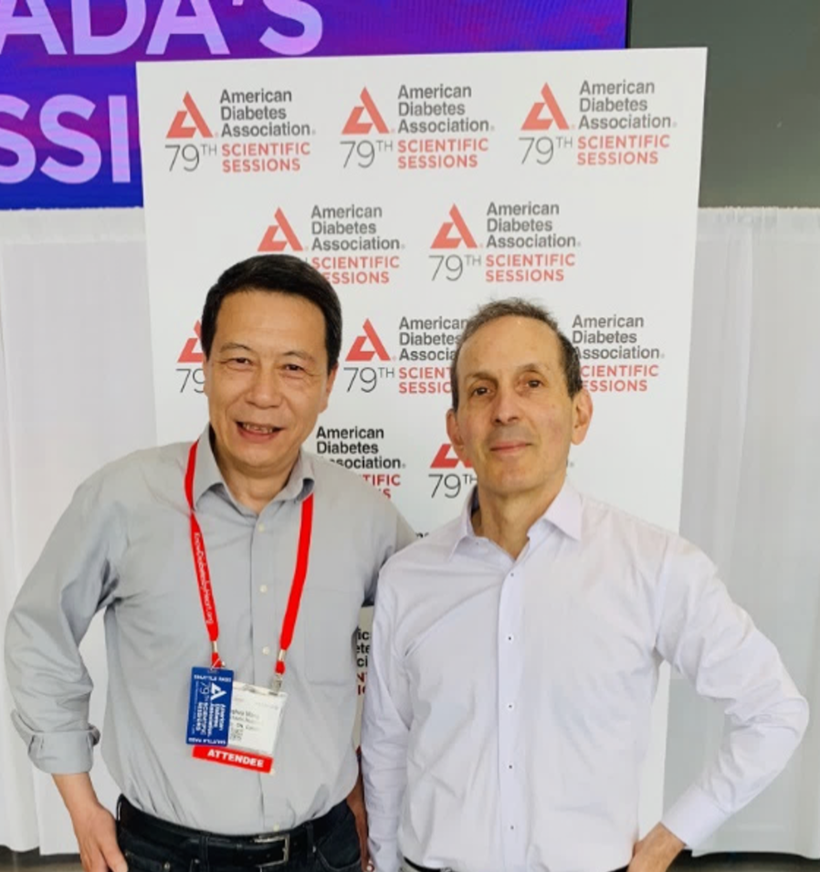
With Daniel Drucker at the 79th ADA Scientific Sessions in 2019. After many years of working in the same field, this became our first—and, to date, only—photograph together.
True pioneers do not necessarily stand in the center of the spotlight.
Sometimes they simply sit, year after year, in the first seat on the left in the front row—listening carefully to what others have to say.
And then, at the right moment, they ask a question, share a mouse model, encourage a young scientist, or help move an entire field one step forward.
This year’s Nobel Prize belongs to the discoveries that made optogenetics possible.
Perhaps the day for GLP-1 will come in another year.
But prizes are never the only measure of a scientist’s influence.
Daniel Drucker’s name is already written into the history of GLP-1 research—and into the lives of millions of people whose health has been transformed by advances built on that science.
Next year, when I walk into an EASD lecture hall, I suspect I will find him where he has always been:
front row, first seat on the left.
And the rest of us will keep trying to do the kind of work he once encouraged us to do—
more work like this.
Qinghua Wang, MD, PhD
Founder, Chairman & CEO, Innogen Pharmaceutical Group
Professor, Huashan Hospital, Fudan University