
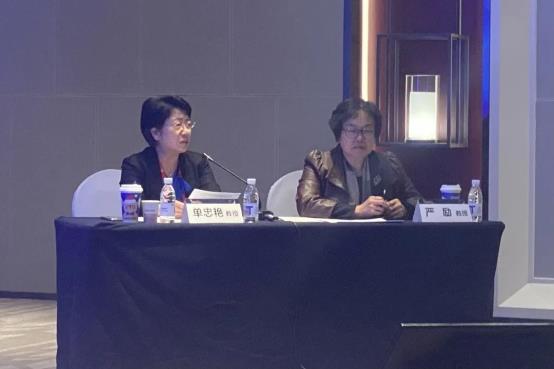
The 20th National Congress of Endocrinology of the Chinese Medical Association (CSE 2023) took place in Qingdao from 6 to 9 December 2023. One of China's principal annual meetings for basic and clinical research in endocrine and metabolic disease, CSE presented developments in several new glucose-lowering medicines. GLP-1 medicines, which are driving a new wave of pharmaceutical innovation, were a focus of clinical discussion. The meeting included a session on current topics in human-derived, long-acting GLP-1 receptor agonists, chaired by Professor Li Yan of Sun Yat-sen Memorial Hospital, Sun Yat-sen University, and Professor Zhongyan Shan of the First Hospital of China Medical University. Professor Ming Liu of Tianjin Medical University General Hospital and Professor Qinghua Wang of Huashan Hospital, Fudan University, presented and discussed supaglutide's clinical value and developments in the GLP-1RA field.
Molecular design supports clinical translation: prospects for supaglutide, a new-generation, human-derived, ultra-long-acting GLP-1RA
At the meeting, supaglutide inventor Professor Qinghua Wang explained the molecular advantages of this new-generation, human-derived, ultra-long-acting GLP-1RA. Supaglutide is a fusion protein linking GLP-1 to a heavy-chain IgG2 Fc fragment through the natural hinge region of immunoglobulin. First, the hinge design strengthens binding between GLP-1 and its receptor, helping improve overall efficacy and prolong activity. Second, because renal excretion is an important elimination pathway for peptide medicines, the IgG2 Fc heavy-chain design increases molecular weight and slows metabolism in the body, producing a mean half-life of up to 204 hours. Third, the lower immunogenicity of the IgG2 Fc fragment helps ensure good safety and tolerability. This distinctive molecular design contributed to favorable results in the two Phase III studies presented. Supaglutide also requires no titration and can be administered in one automatic injection. This improvement in administration reflects Innogen's patient-centered development approach and substantially increases convenience for patients.
With strong glucose lowering, good overall tolerability, moderate weight loss and improvements in central obesity, supaglutide offers a promising option for improving metabolism in Chinese patients with type 2 diabetes who have overweight or obesity.
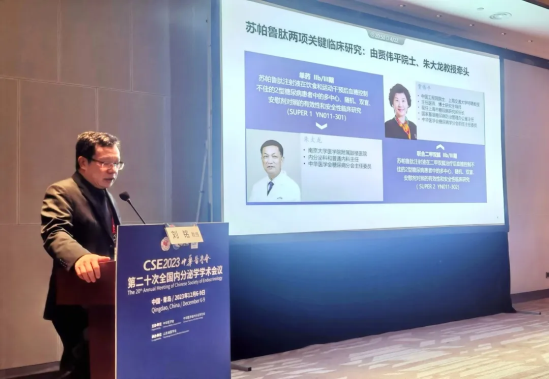
Professor Ming Liu presented ‘Phase III clinical study results for supaglutide in patients with type 2 diabetes,’ giving colleagues a closer understanding of this innovative medicine. The report is summarized below: supaglutide produced strong glucose lowering, reducing HbA1c by up to 2.2 percentage points as monotherapy and 1.8 percentage points with metformin.
Professor Liu reported strong glucose-lowering effects with supaglutide both alone and with metformin. In SUPER-1 (NCT04994288), a Phase III study of supaglutide monotherapy in type 2 diabetes, patients received supaglutide 1 mg, supaglutide 3 mg or placebo. At 24 weeks, the 3 mg group had a 2.2-percentage-point reduction in HbA1c from baseline, significantly greater than the 0.47-percentage-point reduction with placebo (P<0.001), a reduction nearly five times as large.
In SUPER-2 (NCT04998032), a Phase III study of supaglutide added to metformin in type 2 diabetes, patients inadequately controlled on metformin were randomized under double-blind conditions to once-weekly supaglutide 3 mg or placebo, both on a background of metformin. At week 24, HbA1c fell by 1.8 percentage points from baseline in the supaglutide group, a statistically and clinically significant difference from placebo (P<0.001).
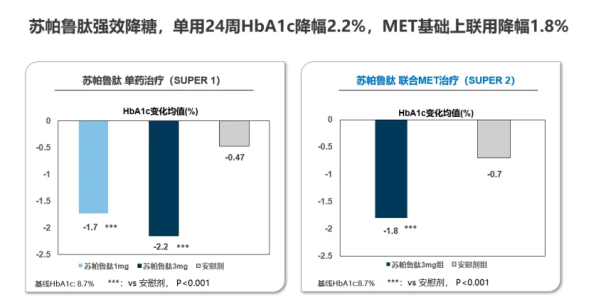
Image text and data — CSE 2023 figure: HbA1c change at 24 weeks
The left graph shows SUPER 1 monotherapy, with baseline HbA1c of 8.7%. Changes from baseline are approximately −1.7 percentage points with supaglutide 1 mg, −2.2 with 3 mg and −0.47 with placebo. Both active-treatment groups are marked P<0.001 versus placebo.
The right graph shows SUPER 2 on background metformin, with baseline HbA1c of 8.7%. Changes are approximately −1.8 percentage points with supaglutide 3 mg and −0.7 with placebo, with P<0.001 for active treatment. The headline highlights 2.2-point monotherapy and 1.8-point add-on reductions at 24 weeks. The figure uses the historical drug name and rounded values.
Rapid onset without dose titration: HbA1c falls by approximately 1 percentage point after four weeks
Supaglutide acted rapidly both as monotherapy and with metformin, reducing HbA1c by approximately 1 percentage point within four weeks. In SUPER-1, the 3 mg group had a 1.1-percentage-point reduction at week 4, compared with 0.3 percentage points with placebo. In SUPER-2, the corresponding reductions were 0.9 percentage points with supaglutide 3 mg plus metformin and 0.4 percentage points with placebo plus metformin. Previous research suggests that earlier improvement in blood glucose helps reduce all-cause mortality and myocardial-infarction risk in people with diabetes. Early intensive glucose-lowering strategies are therefore widely used in clinical practice. The positive findings of these two studies provide an important reference for further clinical research and practice.
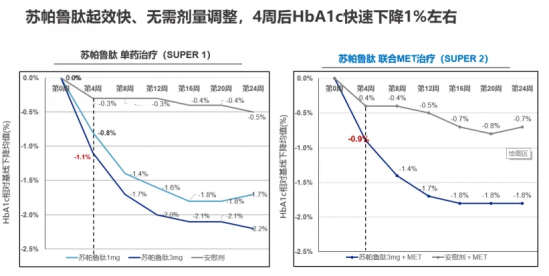
Image text and data — CSE 2023 figure: HbA1c trajectories through week 24
The horizontal axis marks weeks 0, 4, 8, 12, 16, 20 and 24. The vertical axis shows HbA1c change from baseline; the percentages plotted represent percentage-point changes. The left SUPER 1 graph uses light blue for 1 mg, dark blue for 3 mg and grey for placebo.
At those successive timepoints, SUPER 1 values are approximately 0, −0.8, −1.4, −1.6, −1.8, −1.8 and −1.7 points for 1 mg; 0, −1.1, −1.7, −2.0, −2.1, −2.1 and −2.2 for 3 mg; and 0, −0.3, −0.3, −0.3, −0.4, −0.4 and −0.5 for placebo.
The right SUPER 2 graph adds treatment to metformin. Successive values are approximately 0, −0.9, −1.4, −1.7, −1.8, −1.8 and −1.8 points for 3 mg; and 0, −0.4, −0.4, −0.5, −0.7, −0.8 and −0.7 for placebo. Dashed lines highlight week 4. The title describes rapid onset without dose adjustment and an approximately one-point reduction after four weeks. Values reproduce the rounded labels in the historical figure.
Good overall tolerability and suitability for weight management in type 2 diabetes with overweight or obesity
In metabolic control, supaglutide significantly improved glucose tolerance, enhanced meal-stimulated insulin and C-peptide secretion, and improved β-cell function. Fifty-two-week safety data from the two Phase III studies showed good safety and tolerability, with no level 2 or higher hypoglycemia. Nausea, vomiting and other adverse events most likely to prompt patients to stop treatment occurred at lower rates, with important clinical implications for adherence.
In SUPER-2, patients receiving supaglutide 3 mg with metformin for 24 weeks lost nearly 4% of their baseline body weight and nearly 3 cm in waist circumference (both P<0.05). These findings provide an evidence base for its future use in Chinese patients with type 2 diabetes and overweight or obesity. Obesity is a chronic metabolic disease, and clinical care emphasizes healthy weight loss. Indiscriminate or excessive weight loss may cause reduced immunity, gastroenteritis, anorexia, endocrine disorders, hair loss and other health problems, potentially becoming life-threatening in severe cases. Central obesity is the most common form of obesity in China; in adults, it is defined by a waist circumference greater than 90 cm in men or 85 cm in women. Supaglutide's moderate weight reduction and improvement in central obesity make it well suited to weight management in this population. Many patients also want to lose weight without losing muscle. A preclinical study found that supaglutide significantly reduced body weight, mainly by reducing white and visceral fat and improving fatty liver, without reducing brown fat or muscle mass—suggesting potential for fat loss without muscle loss.
A decade of development: a China-originated ultra-long-acting GLP-1RA could expand treatment choices
Professor Li Yan praised Professor Qinghua Wang's decade of persistence and this successful translation of academic research into medicine. She said that, given unmet clinical needs in glucose lowering in China, this new high-quality, convenient option could fill a treatment gap and advance diabetes care. Professor Zhongyan Shan concluded that Innogen's supaglutide is a novel, human-derived, ultra-long-acting GLP-1 receptor agonist whose two Phase III studies involved more than 110 centers and over 1,100 patients with type 2 diabetes. Its molecular advantages offer potential to address treatment gaps, with strong and rapid glucose lowering, a high level of safety and broad clinical prospects without dose titration. It also provides weight-loss and metabolic benefits consistent with guideline recommendations, while preclinical research suggests fat loss without muscle loss. She looked forward to supaglutide becoming China's first independently patented, new-generation, humanized, ultra-long-acting GLP-1 receptor agonist, providing a new diabetes treatment option. Obesity and nonalcoholic steatohepatitis indications are also being developed to benefit more patients with metabolic disease.
References:
1. Guidelines for the Prevention and Control of Overweight and Obesity in Chinese Adults (2021).
2. Front Physiol. 2017 May 15;8:294
Reviewed by: Professor Li Yan, Sun Yat-sen Memorial Hospital, Sun Yat-sen University